 Türkçe
 English
 Nederlands
 Español
 Deutsch
A Visit to Nakivale Refugee Settlement, Uganda
According to 2022 figures from the United Nations High Commissioner for Refugees (UNHCR), the number of people forced to leave their homes worldwide has passed 100 million.
6 min read
According to 2022 figures from the United Nations High Commissioner for Refugees (UNHCR), the number of people forced to leave their homes worldwide has passed 100 million.
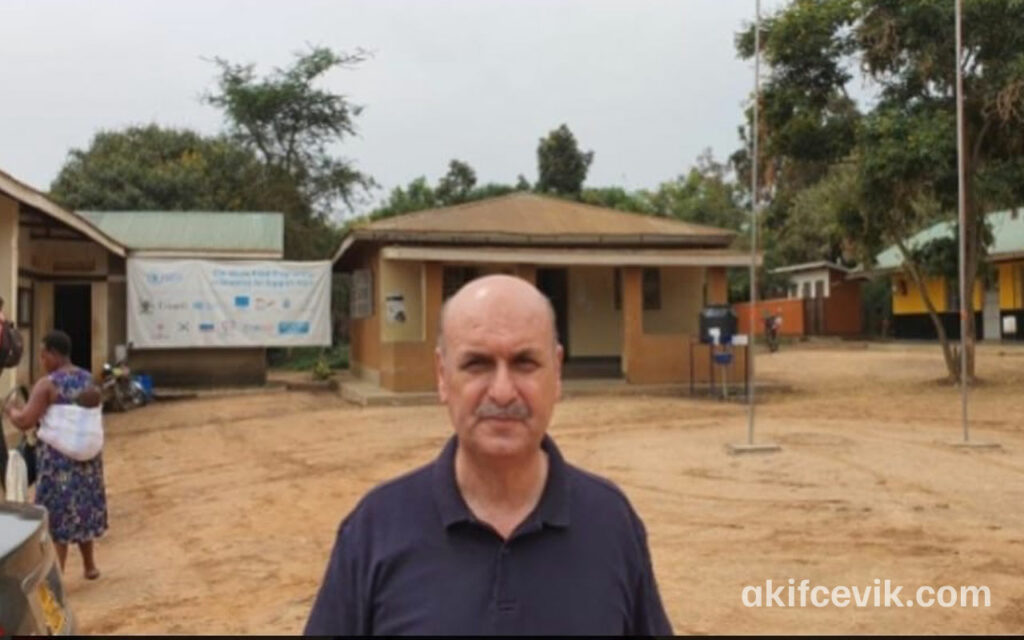
On 9 February 2022 I visited, together with officials from the humanitarian foundation “Nile Humanitarian Development Agency” working in Uganda, a settlement that is home to 138,000 refugees. On the wall of the office providing social assistance there was a motto I read, a single sentence that said everything: “Restoring lost hope and transforming lives…”
For a foundation carrying out humanitarian work in Uganda, getting to know this settlement first, and working out with our partners what might be done, was something like homework.
Nakivale Refugee Settlement, Uganda
It was established in 1958 and formally recognised by the Ugandan government in 1960. It is the eighth largest refugee settlement in the world. It lies roughly 200 km from the capital, Kampala. The settlement covers around 184 square kilometres of rolling hills, fertile fields, a lake and many streams. Geographically it is divided into three administrative zones: the Base Camp, Juru and Rubondo. Across these three zones there are 79 separate villages. The people here have come from the Democratic Republic of the Congo, Burundi, Somalia, Rwanda, Ethiopia, Sudan and Eritrea. As of June 2022 it hosts a total of 138,140 refugees. Although the population is highly mixed, the majority of refugees in the settlement are Congolese, and there are many cultures and groups from different nations. Nakivale refugee settlement lies in the Isingiro district of southern Uganda, close to the Tanzanian border. It is the oldest refugee settlement in Africa.
Life and administration in Nakivale refugee settlement
It is administered by the Ugandan government’s Office of the Prime Minister (OPM). It is formally represented by members elected from the refugee population settled across the three zones. This administration serves for two years, with elections held every two years. It is a refugee leadership structure that helps the OPM govern refugees at village level. Each refugee council is made up of 10 members. The chairperson responsible for running the village is assisted by a deputy, most often a woman.
There is also a general secretary, a secretary for defence, a secretary for women’s affairs, a youth secretary, a secretary for extremely vulnerable individuals, a secretary for education, a secretary for hygiene and sanitation, and a treasurer. Livelihood support in the settlement is backed by the United Nations refugee agency (UNHCR).
Projects that encourage self sufficiency are run in the settlement with the help of international organisations, and these are based largely on agriculture.
Institutional work in Nakivale settlement
- Administration, coordination and security: Office of the Prime Minister (OPM)
- Protection: Humanitarian Assistance and Disaster Relief
- Community services: Humanitarian Assistance and Disaster Relief
- Education: Windle Trust Uganda (WTU)
- Health and nutrition: Medical Teams International (MTI)
- Water and sanitation: Humanitarian Assistance and Disaster Relief
- Livelihoods and environment: World Food Programme
- Shelter and logistics: African Initiatives for Relief and Development (AIRD)
- Promoting refugee artists, young people and women: WAKATI Foundation (WF)
Supporting organisations
- Adult education and youth leadership: Finnish Refugee Council (FRC)
- Encouraging and building young people’s talents: WAKATI Foundation (WF)
- Child protection and monitoring: Uganda Red Cross Society (URCS)
- Psychosocial counselling: Tutapona Community
- Services and sport: Right To Play
Areas of work in the settlement
Protection: The protection sector in Nakivale refugee settlement deals with strengthening protection against crime, reducing or eliminating arbitrary detention, preventing Sexual and Gender Based Violence (SGBV), and providing child protection services for unaccompanied minors.
Support for durable solutions is given through awareness campaigns, “go and see, come and tell visits”, and the identification of individual protection cases for resettlement and voluntary return activities such as accompanying returning convoys.
Community services: This support covers the distribution of non food items, the construction of shelters for people with special needs, and psychosocial support for refugees in vulnerable situations. The vulnerable groups supported include older people, people with disabilities, single parents, unaccompanied and separated children, as well as other men, women at risk, people with medical conditions, children at risk, and women and children more generally.
At the same time there is community work such as water supply and road maintenance within the capacity building of refugee leaders. Education: Nakivale has 9 primary schools and 27 Early Childhood Development Centres, along with 1 secondary school and 1 vocational school.
Windle Trust Uganda (WTU) also runs the German funded DAFI scholarship programme, which supports higher education. Children with special educational needs are supported in 2 schools outside the settlement.
The Vocational Training Centre (VTC) provides skills training to asylum seekers, refugees and Ugandan citizens, giving them the skills needed for informal employment opportunities and small scale enterprise. There is also a Community Technology Access (CTA) Centre, consisting of a training space and an internet café, where students enrol in and take basic computer courses. Alongside this work, the Finnish Refugee Council (FRC) provides adult literacy teaching.
Health: Health services include outpatient department services, immunisation, and community outreach activities such as mobilisation and systems strengthening for sensitisation and antenatal care (ANC). There are 4 health facilities in Nakivale (levels II, III and IV H/C). The main referral points are Mbarara RRH in the nearest town to the settlement, and Rwekubo H/C IV. MTI intervenes in and supports awareness messaging on HIV/AIDS, other communicable diseases, health promotion campaigns, and capacity building for Community Health Workers. Measures relating to maternal and child health have also been taken as part of this work. The most common illnesses in the settlement are malaria and respiratory tract infections.
Around the settlement there are an estimated 35,000 people who benefit directly from its water, education, health and nutrition programmes. The United Nations High Commissioner for Refugees (UNHCR) and the Ugandan government also run sub project activities with implementing partners such as Windle International Uganda, which provide social services for education.
Refugees in Nakivale use both groundwater, through boreholes and shallow wells, and water pumped from Lake Nakivale and treated at one of the settlement’s 3 water facilities (Base Camp, Misiera and Kabazaana). There are 50 water pumps and 318 tap stands in the settlement. Water trucking, to schools and health centres, is used in the dry season, and rainwater in the wet season.
Livelihoods and environment in the settlement: The main livelihood activities include food crop production, including mushroom growing at home, post harvest crop processing, mainly for maize, livestock keeping, small businesses and vocational skills such as tailoring, soap making, baking and handicrafts including slipper making. Charcoal is produced, and cooking bananas are grown. The WAKATI Foundation, a refugee led organisation, runs community based work producing energy saving stoves in the settlement. To support this work, the refugees who benefit have organised themselves into groups and associations. Tree planting is carried out and information on saving energy is provided, in order to encourage conservation and to stop deforestation.
Settlement at Nakivale: Solutions are found by establishing permanent living conditions according to how long refugees stay.
Could we be hope for the people in this refugee settlement?
Reader notes
No one has left a note on this post yet. Be the first.
Related posts
 Social Responsibility
 Social Responsibility